
Towards Automated SOZ Localisation
Motivation
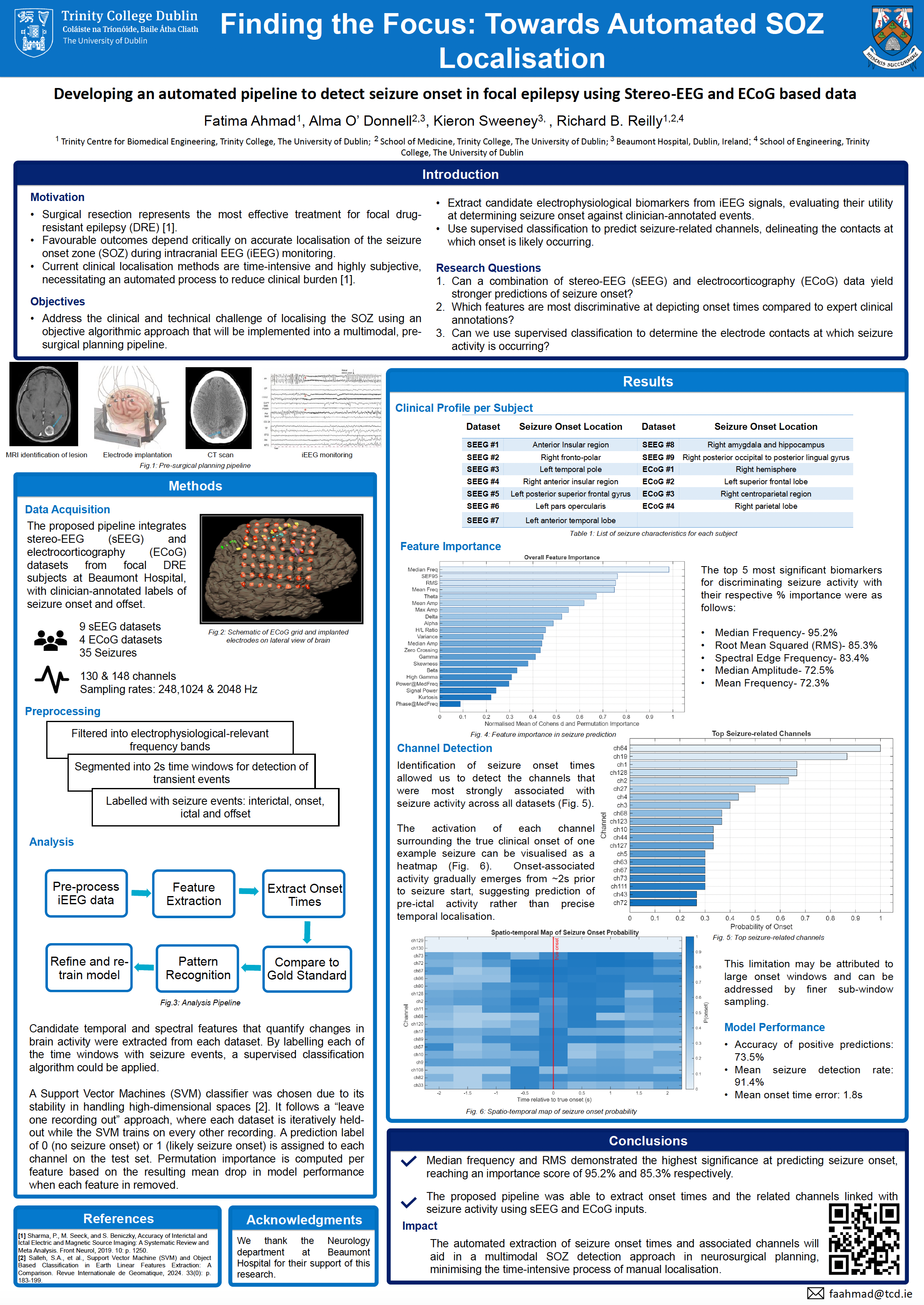
Surgical resection represents the most effective treatment for focal drug-resistant epilepsy (DRE) [1].
Favourable outcomes depend critically on accurate localisation of the seizure onset zone (SOZ) during intracranial EEG (iEEG) monitoring.
Current clinical localisation methods are time-intensive and highly subjective, necessitating an automated process to reduce clinical burden [1].
Objectives
Address the clinical and technical challenges of localising the SOZ using an objective, algorithmic approach to be implemented in a multimodal pre-surgical planning pipeline.
Extract candidate electrophysiological biomarkers from iEEG signals, evaluating their utility at determining seizure onset against clinician-annotated events.
Use supervised classification to predict seizure-related channels and delineate the contacts at which onset is likely to occur.
Research Questions
Can a combination of stereo-EEG (sEEG) and electrocorticography (ECoG) data yield stronger predictions of seizure onset?
Which features are most discriminative at depicting onset times compared to expert clinical annotations?
Can we use supervised classification to determine which electrode contacts are exhibiting seizure activity?
Conclusion
Median frequency and RMS demonstrated the highest significance in predicting seizure onset, with importance scores of 95.2% and 85.3%, respectively.
The proposed pipeline extracted onset times and the related channels associated with seizure activity using sEEG and ECoG inputs.
Clinical Impact
The automated extraction of seizure onset times and associated channels will aid in a multimodal SOZ detection approach in neurosurgical planning, minimising the time-intensive process of manual localisation
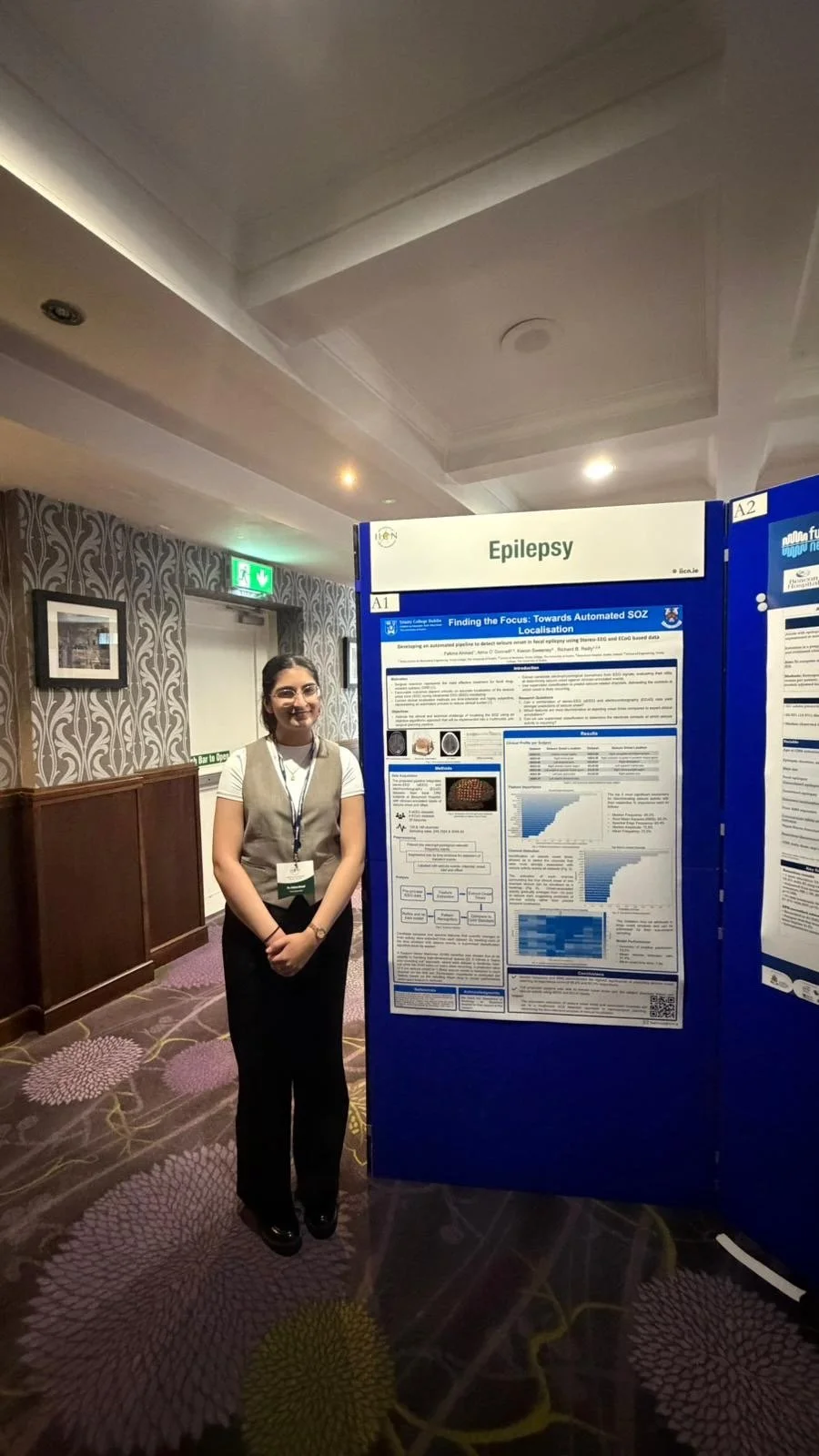
Irish Neurological Association Conference 2026